
BrenX: Efficient Energy Storage for Industry
- BrenX puts its proprietary thermal energy storage technology at the core of integrated energy solutions for industrial and utility customers.
- The bGen system converts renewable or grid-supplied electricity into thermal energy or captures and reuses waste heat, then delivering thermal energy or steam when needed.
- The advent of data centers and expanding technology manufacturing are just sectors driving industrial energy demand.
- The Company’s business model features multiple sales sources from the BrenX integrated energy resource centers as well as fees from turn-key systems at customer sites.
- First energy payoff appears imminent from a project to supply steam to a beverage production facility. The Brenx pipeline features additional projects in the development, construction and commissioning stages.
- Brenx is capitalized principally by sales of preferred and common stock through a securities purchase agreement, especially handy given that the Company is a net user of cash resources to support operations.
- Even as favorable fundamental developments unfold, BrenX shares have traded off from recent highs, providing an entry point for new investors.
INTRODUCTION
The world is experiencing a significant industrial energy shortage, impacting in particular manufacturing and energy-intensive sectors such as data centers. Shifts to electricity hungry manufacturing processes and the adoption of new artificial intelligence-driven applications are important new demand drivers. At the same time geopolitical tensions have adversely impacted conventional energy supply chains, putting pressure on renewable energy production.
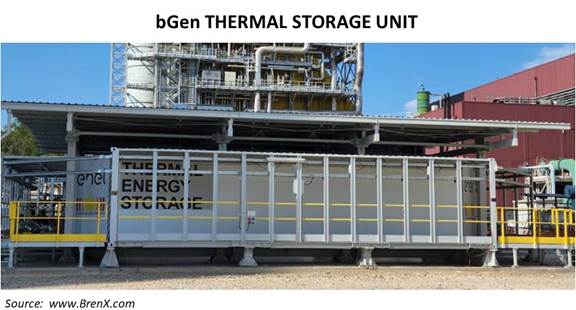
It is an opportune time for new players like BrenX, Inc. (BRNX: Nasdaq) to introduce its novel energy storage solution to industrial and utility customers. The Company’s bGen thermal energy storage system converts electricity from the grid or renewal power systems to thermal power, storing it for industrial customers to use in peak demand periods. The bGen unit can also capture industrial waste heat, further enhancing energy efficiency.
Historically, BrenX had sold its bGen equipment outright. To realize more value from its technology and systems integration expertise, the Company is now offering Heat- or Energy-as-a-Service (HAAS or EAAS) under long-term power agreements. BrenX designs and builds an optimized energy solution for each customer, retaining ownership of system assets. The arrangement reduces upfront capital costs for customers and ensures a more predictable power cost going forward.
A building pipeline of bGen projects suggests the technology is robust and the business model is well marketable. Projects span multiple applications, including utility power, campus, manufacturing, health care facility and renewable energy. In our view, it is timely for investors to consider a long-position in BrenX stock, one of the few publicly traded securities in the Thermal Energy Storage arena.
PROJECT PIPELINE
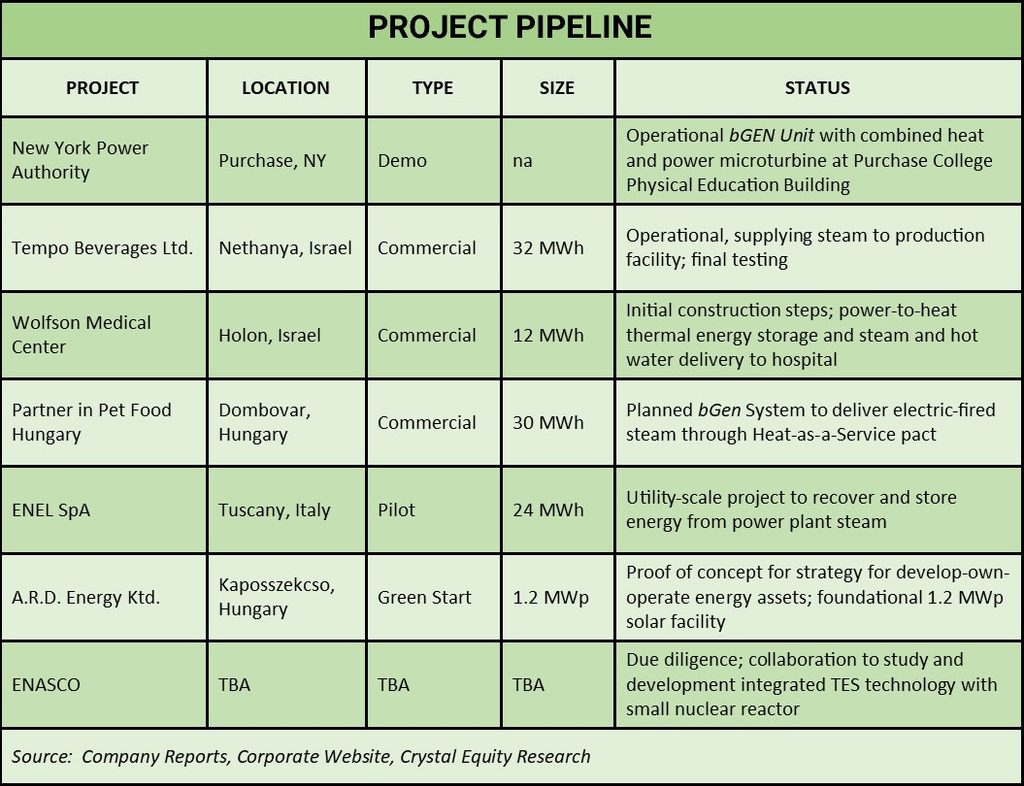
Currently, a bGen Unit is delivering steam to a combined heat and power microturbine in use at the Physical Education Building of Purchase College in New York. The demonstration project is intended to provide supplemental heat during periods of peak demand, thereby meeting all of the building’s heating needs. Many institutions have varied thermal demands due to shifting use patterns and seasonal changes. Building owners are also challenged to reduce carbon emissions.
The New York project has been a good marketing and sales tool, helping BrenX land other commercial projects. Indeed, a bGen solution for a beverage company is operational, supplying steam to a production facility located in Nethanya, Israel. The thermal energy storage system rated at 32 MWh will supply all of the steam for the facility under a Heat-as-a-Service agreement. The customer, Tempo Beverages, majority owned by the Dutch beer company Heineken N.V. (HEIA: AS), is conducting final tests.
Particularly interesting in the BrenX project pipeline is a bGen integrated system to deliver steam to a pet food production facility. Located in Hungary the project is designed to provide multiple functions of electrical charging, grid balance and process-heat dispatch. The project is in the planning and design stage and when completed is expected to deliver up to 30 MWh of energy to the customer pursuant to a twelve-year Heat-as-a-Service arrangement.
Plan to Capture More Value with Build-Own-Operate Energy Strategy
BrenX has taken a significant step in its strategy to own and operate integrated energy assets with the $1.1 million purchase of a 1.2 MWp solar facility in Hungary. Fully operational the solar facility is a solid foundational asset owned by the Company’s Hungary subsidiary A.R.D. Energy. In late August 2026, the Company took steps to acquire adjacent land and more photovoltaic infrastructure. The added space should make it possible to add bGen energy storage units as well as equipment needed to connect additional power generation or delivery equipment.
Progress with the A.R.D. Energy project should be of particular interest for investors. Management speaks with enthusiasm for the project to serve as a blueprint for the build-own-operate strategy.
BrenX generously shares numerous images of bGen thermal energy storage units and project progress at the BrenX Corporate Website.
MARKET OPPORTUNITY
Europe, which is the Company’s primary target market, is well disposed to receive new market entrants like BrenX. A review of industry research reveals a large market opportunity, double digital growth prospects, and favorable dynamics in the European energy storage market.
The European energy market is significant in size with numerous well-diversified competitors. According to an industry research firm, Market Data Forecast, the European energy market was valued at $1.48 billion in 2025. Growing at a compound annual growth rate of 5.23%, the firm estimated the market could reach $2.35 billion by 2034. Electrification of transport and industrial processes as well as the digitalization of grid infrastructure with smart meters are three of the most significant growth drivers.
Importantly, the European energy market is highly dynamic and under pressure to increase energy supplies from clean energy sources to meet increasing demand. Even as regional conflicts in Ukraine and Iran have disrupted energy supply lines, the European Commission has retained aggressive decarbonization targets to take the region to net-zero by 2050. As a consequence, the sector is undergoing a restructuring with conventional utilities, renewable energy developers and technology service providers like BrenX migrating into new roles and cooperative arrangements.
New Interest in Energy Storage Opens Door to BrenX
The vibrant European energy market is putting new emphasis on energy storage capacity that helps balance renewable energy intermittency as well as promoting efficiency in power usage. To be clear, Thermal Energy Storage (TES) includes systems that capture heat and then discharge it on demand. Industry research firm MarketWide Research pegged the TES market at $3.8 billion in 2026, growing at a compound annual rate of 14.2% to reach an estimated $12.55 billion by 2035.
Industrial heat buyers are apparently seeking single solution providers with energy delivery contracts on offer. Equipment procurement with the attendant operational risk do not compared well to lower capital costs and long-term contracts with guaranteed heat delivery metrics. The BrenX Heat- or Energy-as-a-Service innovation appears to be just what Europe’s manufacturing and industry players are looking for.
COMPETITIVE STRENGTH
If innovation could be the key to success in the European market, BrenX has a compelling story. It is among few thermal energy storage companies to use crushed volcanic rock to store heat. Charged by electricity from the grid or from renewable energy sources, heaters in the storage unit convert the electricity to heat up to 1200 degrees Fahrenheit (650 degrees Celceus). The bGen system then discharges the energy as steam or hot air when the customer needs it.
Systems are easily scaled to the appropriate capacity with modules the Company calls bCubes manufactured at BrenX’s purpose-built facility. The ability to manufacture the core storage units at a central location can reduce time-to-completion for some projects. For example, the Company recently announced the receipt of building permits for a bGen system at Wolfson Medical Center in Israel. The project now moves immediately to installation and integration at the site using ready bCube modules. Commissioning is expected in approximately twelve months.
Few moving parts and low-priced rock storage medium support low maintenance costs and longer operational life, features of the bGen solution that must grab the attention of power users or grid operators. However, prospects may also find a bGen system simply offers better economics.
In the case of the Wolfson Medical Center, operators are anxious to replace expensive and environmentally unsound fuel oil-fired boilers. The bGen system will convert electricity sourced from the grid during off-peak hours into steam delivered as the medical center requires. Carbon emissions are expected to be reduced each year by 3,900 tons of carbon dioxide equivalent. A Heat-as-a-Service contract informs Wolfson of an estimated cost of $3.7 million over the seven-year term, representing an energy cost savings of approximately $1.5 million each year.
FINANCIAL POSITION
Since shifting away from equipment sales, the Company has not recorded revenue. The Company is a net user of cash resources to support operations, reporting $5.5 million in negative cash flow from operations in the first six months of 2026. The most significant use of cash was general and administrative activities followed by research and develoment efforts.
Consequently, with important progress at the Wolfson Medical Center project, investors may be anxious to determine the impact on BrenX revenue and cash flows. The Wolfson system has been acquired by Baran Energy, the renewable division of energy developer Baran Group. Baran agreed to pay $2.3 million plus a share of future profits over the seven-year period that begins with commissioning and commercial production of steam.
BrenX also sold the bGen system for the Tempo Beverage production facility to Baran. In the case of both projects, Baran agreed to make milestone-based payments to support manufacture of bCube modules. So far Baran has paid $474,000 in the year 2025, $838,000 in the first six months of 2026 for bCube units and another $833,000 in July 2026.
Historic financial performance figures and recent capital raise events discussed here as well as the balance sheet estimates shown in the capitalization table below are detailed in the Company’s second quarter 2026 financial report and a registration statement filed with the SEC on September 25, 2026.
Strategy to Capture Project Value
The Company has an umbrella cooperation agreement with Baran Energy signed in early 2025. Management clearly values the Baran relationship as the Tempo and Wolfson purchase agreements have accelerated cash flow to cover manufacturing costs. However, additional sales to Baran are not certain.
The overall BrenX strategy is to capture more equity in energy projects, and has begun working on a fully integrated energy project in Hungary. Anchored with an existing solar power facility, BrenX will build, own and operate the energy assets, capturing all project revenue and profits. A build-own-operate strategy is by necessity capital intensive, putting pressure on BrenX to find inexpensive financing for manufacturing and construction.
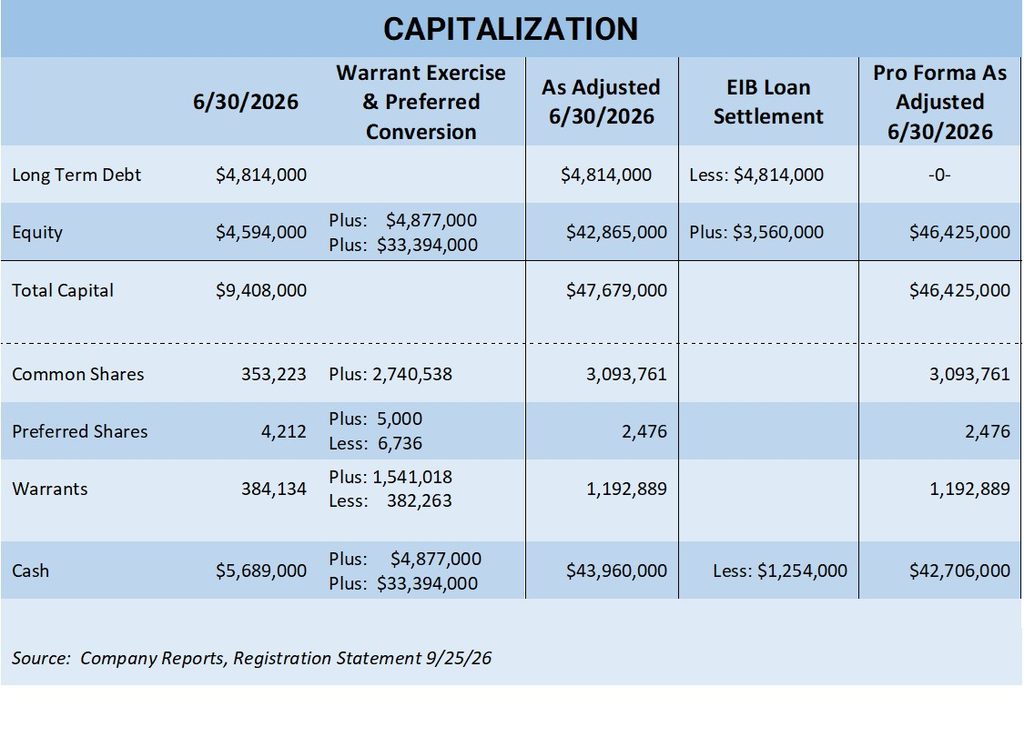
The Company has been capitalized by both debt and equity. The end of June 2026, the last date at which the Company has reported its financial profile, debt and equity were nearly equally balanced at $4.8 million and $4.6 million respectively. Subsequent to the second quarter end, BrenX has moved to settle a long-term loan with the European Investment Bank, a move which will result in an increase in equity by $3.6 million. Equity will then represent 100% of the Company’s capital resources. Notably, cash will be reduced by $1.254 million as BrenX is required to make a one-time payment pursuant to the debt settlement agreement.
More pertinent for investors is the potential for dilution due through the issuance of stock and warrants. Subsequent to the quarter ending June 2026, the Company raised $5.0 million in new capital through the sale of 5,000 shares of preferred stock and 1,457,685 common stock warrants pursuant to an existing securities purchase agreement with an institutional investor.
Understanding Dilution and Capital Flows
The capitalization table below includes the recent capital raise events and illustrates the balance sheet changes that come about as preferred stock is converted and warrants are exercised. In its September 2026 registration statement, the Company discloses that 2.7 million shares of common stock could be issued primarily related to the conversion of 6.7 million shares of preferred stock and the exercise of 382,263 warrants. While the Company would receive no additional capital upon conversion of preferred stock, exercise of warrants could bring into the Company’s coffers as much as $33.4 million in new capital.
More likely the warrant exercise could raise less than estimated, as the exercise price is subject to negotiation and adjustment. Indeed, the Company recently agreed to a significantly lower exercise price of certain warrants from $87.36 to $12.00. Additionally, the conversion ratio for certain preferred stock has also been adjusted downward, potentially leading to the issuance of more common stock than previously estimated. Nonetheless, the table below provides a view on how convertible preferred stock and warrants impact both equity and cash resources.
While dilution is certainly a relevant consideration, in our view, even more important is the adequacy of cash resources to reach important milestones. We estimate the Company may have as much as $7.0 million in the bank at the end of September 2026. The estimate is based on the reported cash balance at the end of June 2026, the sale of preferred stock and warrants, a payment from Baran Energy, the use of cash resources to support operations and the purchase of a solar facility in Hungary. This estimate suggests BrenX has sufficient cash resources to support operations well into the year 2027, and giving the Company time to execute on its project pipeline.
VALUATION
Determining a fair value for BrenX is challenging given the present financial profile with zero sales and net losses upon which to base the usual discounted cash flow valuation method. Furthermore, there are no companies in the thermal energy space that have publicly traded shares to use for a comparable valuation effort.
The broader industrial energy space includes Bloom Energy (BE: NYSE), Brookfield Renewable Partners (BEP: NYSE) and Ceres Power Holdings, Plc (CWR: London), among others. Mature players with well established footprints in world energy markets, the stocks of these companies reflect the importance investors place on success in the sector. Even if not appropriate comparable stocks, these stocks can inform investors ofdirection change in valuation and sector sentiment.
Shifting priorities for European industrial energy users, as noted above, could lead to collaboration among such well-established industrial energy suppliers and technology innovators like BrenX. Indeed, BrenX has already joined up with Italy-based utility giant Enel SpA (ENEL: MI) to established a pilot project focused on efficient storage and distribution of industrial steam power. The pact shines a favorable light on BrenX as a reliable innovator in the industry energy market.
So far traders seem to have little of such valuation arguments. The stock price has taken a drubbing for months. A review of historic trading suggests that at least some investors are particularly sensitive at the $3.75 to $4.00 price range where volume-at-price measures are significant. As BRNX has traded below this level, trading volumes dwindled. This suggests that the most recent price capitulation was not widespread.
While not the conclusion of a detail valuation effort, we suggest the $3.75 to $4.00 price range could be considered a target price for the shares. Accomplishment of promised milestones could push the share price back higher. However, clearing the key price range could require a major fundamental accomplishment such as a new development project.
RISKS
Dilution through the issuance of new stock has already been identified as a potential concern for existing shareholders. We have also noted uncertainty in valuation that could drag on the share price in the near-term.
Energy demand and supply conditions, particularly in Europe where BrenX is concentrating its marketing efforts, appear favorable for new competitors. However, the sales cycle could be lengthy given that prospects are often comparing the BrenX energy storage solution to competing solutions. There are also risks that even once agreed upon, projects could get delayed by regulatory review, permitting or financing efforts by counter parties. Delays could weigh on the stock price.
Investors would also due well to consider a fairly wide bid-ask spread in BRNX. The recent spread as a percentage of the BRNX ask price was 16.75%. Generally, a spread percentage above 2% is considered indicative of low liquidity and higher volatility.
LONG-VIEW FOR RISK TOLERANT INVESTORS
A building project pipeline makes BrenX an attractive vehicle for participating in the fast-growing energy storage market. A string of announcements suggest the team has been effective capturing customers and in propelling projects to commercial operation. Still, long positions in BRNX are most suitable for risk-tolerant investors with the patience to give management time to execute on the Company’s business strategies.
Neither the author of the Small Cap Strategist web log, Crystal Equity Research nor its affiliates have a beneficial interest in the companies mentioned herein.
Underwriters of the Prime series may have a beneficial interest in, serve as agents of, or act as advisors to the companies mentioned herein.