- Driven by artificial intelligence and machine learning technology, Cyabra’s platform identifies manipulated content and attacks online against government, enterprise and brands.
- Since introduction in 2022, a steady stream of customer engagements has proven the platform is robust and effective.
- Cyabra’s annualized recurring revenue run rate was $8.1 million at the end of June 2026, based on in-place subscriptions and licenses.
- Year-over-year growth in reported revenue was 26% in the most recently reported six-month period ending June 2026.
- Recent new customer announcements in entertainment and food/beverage sectors suggest Cyabra’s marketing sales strategy is gaining traction and top-line momentum should continue.
- CYAB has limited trading history and the share price may not reflect the full potential of Cyabra’s technology and products.
- As the only publicly traded solutions provider of the narrative intelligence solutions, CYAB offers singular means to participate an emerging, fast growth sector.
Breaking News! Your favorite fast fashion house is abusing their employees with long hours and people are falling ill…or at least that is the message someone has posted on a popular social media site. New posts coming in claim it is a false rumor. In the confusion, it is better to go the extra distance to buy from a more reputable clothing brand.
Fake news, as in the scenario above, deepfakes and other false narratives undermined customer trust. It festers on any electronic device connected to the Internet – shopping sites, classrooms, news sources, government platforms and political boards.
Unfortunately, it has become pervasive as one in five online product reviews are deemed fake. Over 20% of political campaigns in the U.S. have been found to use fake social media accounts to spread misinformation.
It is a costly situation from the stakeholders’ perspective. Fake online reviews alone are estimated to cost e-commerce businesses $120 billion annually. Harm from misinformation is also measured in the loss of reputation and confidence. Over 50% of voters say political misinformation makes it hard to have productive conversations. Notably, the source of these tidbits, Worldmetrics, completed a four-step verification process before publication.
Defense Against Malicious Content
The stark reality of fake representation is fueling demand for the ‘narrative intelligence’ solutions offered by Cyabra, Inc. (CYAB: Nasdaq). The Cyabra platform relies on artificial intelligence and machine learning technologies to monitor online content relevant to their clients. Proprietary algorithms scan material across social media, news sites, and even into fringe platforms and the ‘dark web’ to expose false messaging as it originates. Armed with an early alert and detailed analysis, customers are in a better position to form a timely and effective response.
Founded in 2019, Cyabra has won a mix of enterprise and government customers which subscribe to the platform as software-as-a-service or license an onsite application. A scroll across Cyabra’s corporate website discloses a few customers such as WarnerMedia and elfBeauty as well as NATO and the U.S. Department of State.
Recent new customer announcements confirm market penetration into new verticals.
- In early August 2026, Cyabra announced it had been selected to provide a government intelligence agency in the Asia-Pacific region with AI-driven monitoring services to detect disinformation and state-sponsored manipulation. The pact covers multiple years and is valued at six-figures.
- Later in same month, the Company announced an agreement to discover coordinated and inauthentic activity for an interactive entertainment and gaming company. The engagement is valued at six-figures annually.
- Within days, the Company also announced an engagement by a Fortune 500 company in the food and beverage sector. The Cyabra platform will monitor and investigate critical brand discussions to detect coordinated influence activity.
Demand Translated to Revenue
Revenue has ramped steadily since the Cyabra platform debut in 2022. The Company reported $3.3 million in total sales in the six months ending June 2026, compared to $2.6 million in the same period in the previous year. In our view, year-over-year growth of 26% at the topline suggests healthy demand and effective customer conversion.
Unfortunately, at this early-stage top-line momentum still has not delivered profits. The operating loss in the first half of 2026, was $14.9 million due in large part to a surge in research and development investment in the first three months of the period to $5.5 million. The Company also reported a significant increase in spending on general and administrative activities to $6.3 million in the early part of the year as Cyabra completed a business combination with a publicly company. For the full six months R&D activities rang up $7.5 million in G&A spending was $7.6 million.
Notably, during the first half of 2026, management used $7.5 million in common stock to pay for certain operating costs such as advisory services. Along with favorable working capital account adjustments, cash usage to support operations was minimized to $5.0 million.
(The foregoing and all other references to corporate reports and news rely on Cyabra’s official filings with the U.S. SEC.)
Capital Management Through Equity Issuance
Clever use of publicly traded common stock as ‘currency’ has not precluded the need for additional financing. In December 2025, Cyabra raised $8.0 million in new capital through a private placement of convertible preferred stock and warrants. The preferred stock has since been converted to common stock. More recently in early July 2026, the Company raised an additional $6.0 million in gross proceeds from the sale of 12.6 million shares of common stock and pre-funded warrants to purchase 13.8 million common shares.
We estimate the Company has cash resources to support operations through the beginning of 2027. Our view on financial resources is based on a ‘back of the envelope’ calculation of $4.6 million as Cybara’s cash balance at the end of August 2026. This compares to $794,000 in cash at the end of June. Our estimate considers the impact of estimated net proceeds of $5.4 million from the July 2026 capital raise and cash usage at a rate of $800,000 per month similar to the three months ending June 2026. Our estimate does not include the cash impact after on-boarding of recently announced new customers.
Leading the Competitive Pack
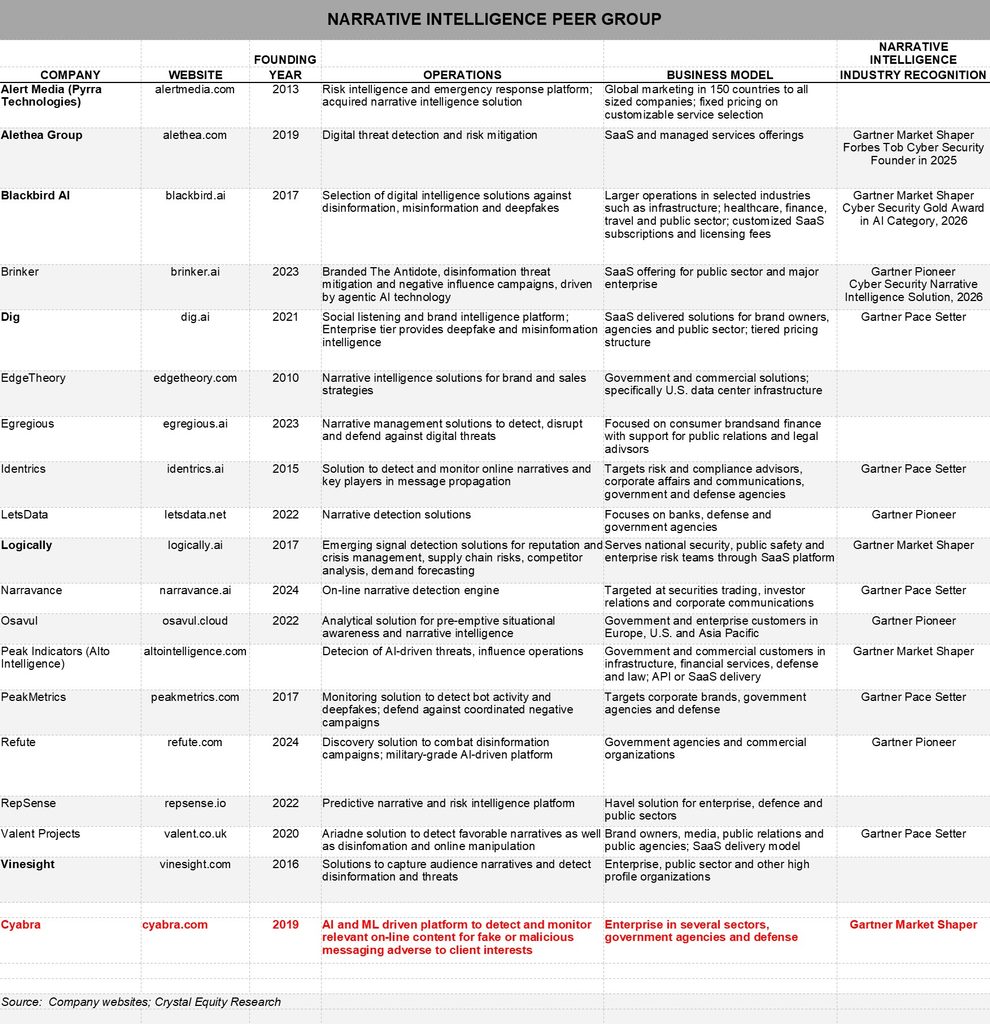
Narrative intelligence products do not fit neatly into recognized industry sectors. Cybersecurity services providers are focused inward toward client-owned systems and networks. Cyabra and its peers are more like social listening and consumer intelligence services by looking outward at Internet content at large. However, to find fake news and false claims, narrative intelligence solutions must go well beyond monitoring the usual social media platforms.
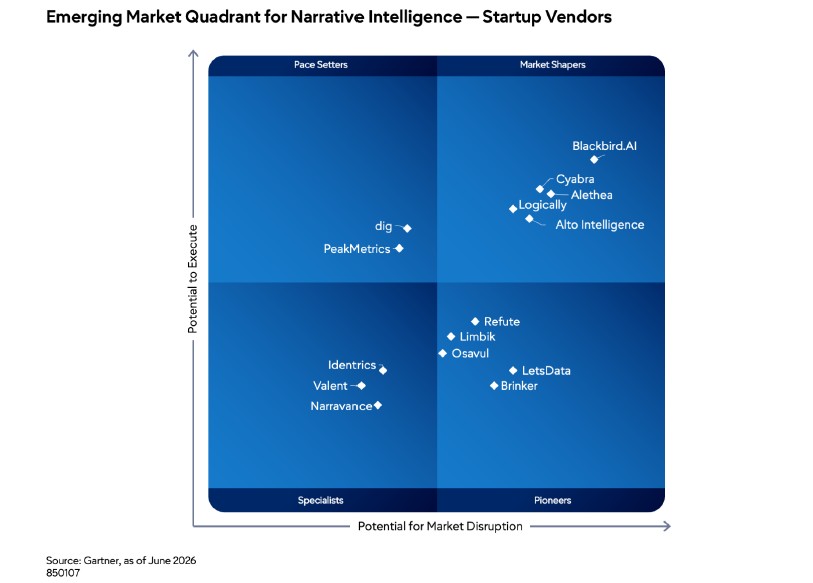
The market research firm Gartner Group recently acknowledged ‘narrative intelligence’ as an emerging market. Our review of the Gartner’s market list published in July 2026, revealed narrative intelligence solutions have been around less than a decade. The emergence of artificial intelligence and machine learning technologies over the last decade has facilitated the development of algorithms necessary to nose effectively around the deep reaches of the worldwide web where malicious influencers and imposters often originate misinformation and adverse campaigns.
Gartner’s ground breaking report named fifteen vendors in its signature ‘quadrant’ format. Cyabra is among the most seasoned players named in the report, beginning technology development in 2017 and introducing market-ready solutions in 2022. The Company is identified as a Market Shaper, second only to one other firm in ‘potential to execute’ and third in ‘potential for market disruption’. By Gartner’s measure, potential to execute is based on financial backing, established customer base, employee experience and market partnerships. Capacity for market disruption is contingent upon robust technology to do more than just ‘listen’ by processing sizable real-time data streams from fringe web sites to conventional social platforms.
Market Opportunity: Costs of Inaction
Gartner’s analysts predicted that 45% of chief communications officers would adopt narrative intelligence solutions by the year 2029. That is not surprising given that the World Economic Forum rates the spread of misinformation and fake news among the world’s top global risks.
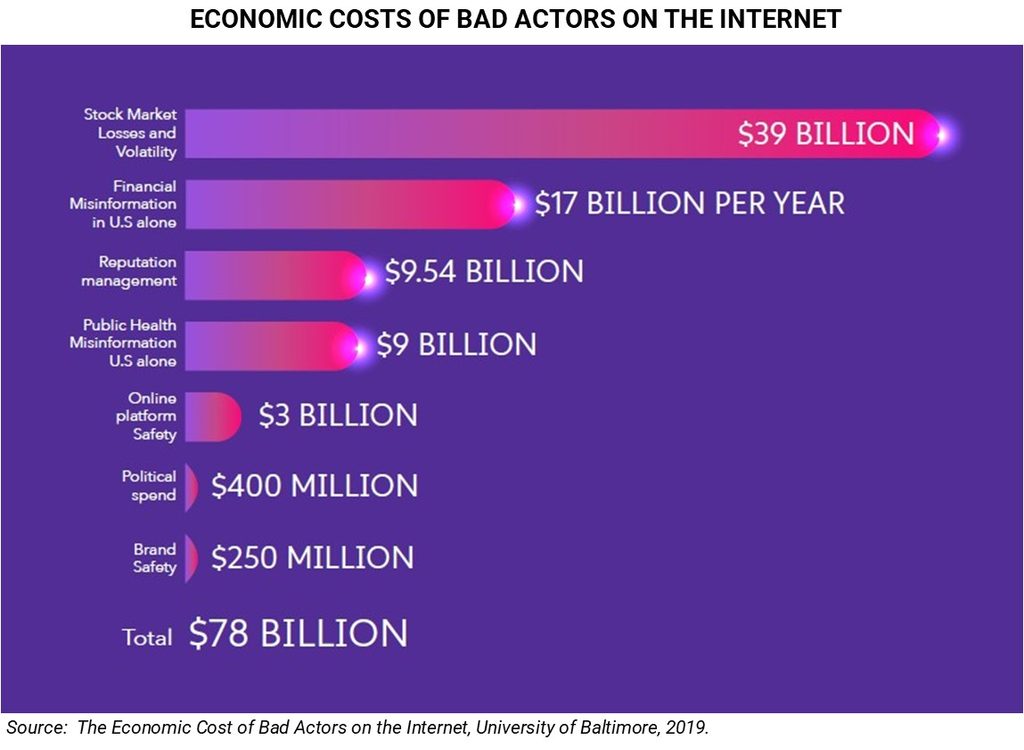
While investors can readily find estimates for the cybersecurity market opportunity, there is limited information published specifically for narrative intelligence. To assess the revenue potential for narrative intelligence solutions, we considered the risks motivating potential buyers. That is, what it costs to suffer a misinformation attack and do nothing.
In 2019, the University of Baltimore in cooperation with cybersecurity firm CHEQ, completed a study on the economic cost of bad actors on the Internet. The study concluded costs related to fake news totaled a whopping $78 billion. Additionally, attacks by opportunistic bots were estimated to result in an estimated $10 billion in losses for global businesses. The CHEQ report is still frequently cited to quantify risk associated with nefarious Internet activity, most recently by the World Economic Forum in its 2025 Global Risks Report.
Marketing and Sales: Sizzle in the Pitch
The Cyabra sales teams are not necessarily relying on comparisons of product and service fees with scary stories of ‘do nothing’ costs. Prospects are often swayed by referrals and reference relationships and Cyabra has strong use cases and success stories to make their case. Technology show-and-tell sessions can put sizzle in the pitch, but according to Cyabra leadership, their products’ accuracy scores are really what sparks interest.
Furthermore, the Company is not relying exclusively on direct sales to engage prospects. Cyabra has a strong partnership program for players with complementary products and services. For example, Hootsuite’s recently acquired Talkwater subsidiary with its Lumen consumer intelligence platform facilitates conversations with brand owners who want to go beyond social listening to get more detailed narrative analysis. Meltwater and Onclusive are two additional partners that provide social listening services to enterprise.
For an emerging player like Cyabra, channel partners can help get across the thresholds of larger organizations. For example, IT solutions provider Carahsoft provides Cyabra with access to large government agencies and specialized sectors such as health care and education. Carahsoft acts as an umbrella for large customers to coordinate multiple technology vendors in a single solution. Cyabra also gets exposure from technical intermediary SoSA Corp., a resource for corporations and government agencies to connect with start-ups and cutting-edge technology.
Valuation: suspiciously priced too low
Cyabra shares began trading in March 2026, giving the stock just six-months trading history under current operations as a narrative intelligence solutions provider. The Company did not follow the typical initial public offering route that wins investment banking sponsorship, analyst coverage and an institutional entourage.
Still relatively unseasoned, the stock may not fully reflect the Cyabra’s future earnings potential. The stock is currently trading at 1.14 times trailing revenue per share and, of course, its price-earnings multiple is negative. We suspect undervaluation.
Out of hand, we rejected the discounted cash flow method for valuing CYAB. The method requires projection of future profits based on what could be an unstable stack of assumptions. Since there are no other public companies among the Company’s peers in the narrative intelligence sector, there is no publicly available data to infer sector growth rates or profit margins.
Furthermore, management provides no formal guidance. That said, in January 2026, at the time of Cyabra’s then proposed combination with a public entity, the Company published in its proxy filing with the U.S. SEC fairly detailed financial projections through the year 2029. Unfortunately, even the near-term the predictions turned out to be overly optimistic. Namely, 2025 revenue was projected to reach $7.3 million, but was reported well below at $5.7 million. Revenue in the year 2026 was projected to reach $14.2 million, but based on the $3.3 million in total sales already reported for the first half of the year, the Cyabra folks are in a tough race to the finish line.
With a little nudge, management did acknowledge the Cyabra business model could resemble companies in social listening in terms of costs and spending priorities. Eureka! There is one publicly trading company that recently acquired a social listening operation. Unfortunately, data from that single company is more a reflection of its historic media management services and its merit in a stock market other than Nasdaq where CYAB trades.
In our view, the cybersecurity sector is a valid alternative to inform valuation of CYAB using the well-recognized comparable method for valuation. Cybersecurity solution providers serve many of the same customers and have a similar operating model dominated by research and development spending as well as marketing through direct sales and channel partners. A group of 50 companies in the threat intelligence niche trade at an average 14.9 multiple of enterprise value to revenue (FINRO Financial Consulting), well above the current price/sales multiple for CYAB.
This approach suggests CYAB could be valued over $4.00 per share based on the Cyabra’s annualized revenue run rate of $8.1 million and the cybersecurity group enterprise value-to-sales multiple. We adjusted the cybersecurity sector multiple by 25% to take into consideration Cyabra’s smaller size, shorter market history and limited trading experience relative to the comparable group. (See our calculation at the end of this article.)
Gaining Fair Treatment
Adjustment to a fair price for CYAB could take some time. As already noted, Cyabra a newly minted public company and the narrative intelligence sector is only just recently recognized. More fans and followers are needed.
Leadership is challenged to gain visibility with traders and investors. Fortunately, the team is in a position to leverage the name recognition and reputations of directors, including former U.S. Secretary of State Mike Pompeo, and serial entrepreneur Sonny Vu.
The Cyabra business model also affords frequent announcements of new customer and contract renewal activity. Indeed, recent customer announcements in the month of August 2026, appears to coincide with increased trading volume reaching an average 23 million shares per day in the last half of August compared to an average 5 million per day over the previous three months.
Investors should not overlook another critical catalyst that could gain new interest and shift investor sentiment. The narrative intelligence sector is beginning to consolidate through mergers and acquisitions. Our field work found that several narrative intelligence solution providers have been snapped up by companies with complementary products and services.
- For example, in 2016, data services and analytics consultancy Peak Indicators snapped up Alto Intelligence to cross-sell narrative intelligence solutions to Peak’s established customer base. Alto was recently recognized by Gartner Group as a Market Shaper in the narrative intelligence sector.
- In April 2024, Alert Media acquired Pyrra Technologies to add narrative intelligence solutions to its risk detection and emergency response services for corporations.
- More recently in August 2026, Burson, Plc. picked up Limbik and its Decipher cognitive AI platform used to predict the impact of content. Reportedly, Burson wanted to bring in-house Limbik’s engineering and research capacity to create new bells and whistles for Burson’s reputation management services. Limbik’s co-founders have been installed as Burson’s global heads of innovation.
A deal could have a significant catalytic impact on the CYAB price. Cyabra management makes it clear their plan is to be an acquiror and not a target. It is not an unreasonable scenario. Sellers could be won over if Cyabra offers its publicly traded shares for the purchase consideration. Furthermore, Cyabra’s chief financial officer, Yael Sandler, has extensive experience in financing and closing deals.
Conclusion
CYAB shares are a singular vehicle for a stake in an appealing sector. Narrative intelligence features a large market opportunity and strong demand by numerous prospects among corporations and government agencies.
Nonetheless, Cyabra is subject to all the business risks of a young company with a limited visibility on the business pipeline and future profits. Accordingly, the shares are suitable for risk tolerant investors with the patience to wait for Cyabra’s business strategies to unfold.
Management’s financial projections may have turned out to be aggressive as far as revenue was concerned, the model was nonetheless informative of the business model. Breakeven was projected when revenue was expected to reach $27.5 million. Based on the current annualized sales run rate near $8 million and the recent ARR growth rate near 30%, that top-line goal could be reached in four to five years. Investors can watch for an acceleration in sales activity to gauge progress toward positive cash flow. In the meantime, the CYAB price gives investors a low-priced ticket to play in this interesting sector.
Neither the author of the Small Cap Strategist web log, Crystal Equity Research nor its affiliates have a beneficial interest in the companies mentioned herein.
Underwriters of the Prime series may have a beneficial interest in, serve as agents of, or act as advisors to the companies mentioned herein.
Our Value Calculation:
$8.1 mln revenue (ARR) x [14.9 EV/sales multiple x (1 – 0.25 discount)] = $75.3 mln enterprise value
$75.3 mln – $2.0 mln. debt + $0.8 mln cash = $74.1 mln market capitalization
$74.1 mln / 17.6 mln shares oustanding (as of 8/10/26) = $4.21 per share
Sources:
Worldmetrics: https://worldmetrics.org/misleading-statistics/
U.S. Securities and Exchange Commission (SEC): https://www.sec.gov/edgar/
World Economic Forum: https://www.weforum.org/
Gartner Group: https://www.gartner.com/
FINRO Financial Consulting: https://www.finrofca.com/news/cybersecurity-valuation-multiples-2025